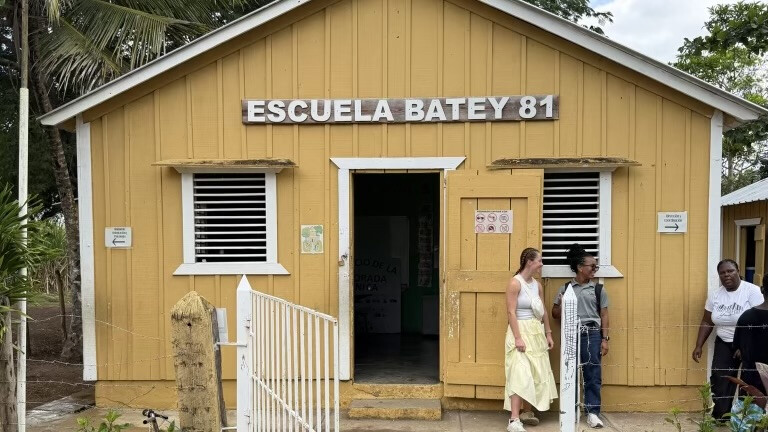
As most of you know, I just returned from my second medical mission to the Dominican Republic. Hopefully, it will not be my last. Many of you here at St. Dunstan’s, both adults and youth, have been a part of this important work, either in the Dominican Republic or the Lakota Sioux Reservation in South Dakota, and know what a life-changing experience these mission trips can be. Originally a partnership between St. Dunstan’s, St. Mary’s in Cypress, and Good Shepherd in Tomball, this particular mission trip has been ongoing for many years. Comprised of both adults and youth, medical professionals, clergy, and lay persons, it is an opportunity to put faith into action through compassionate service. We travel to underserved communities, mostly the bateyes and barrios, to provide basic medical care, health education, spiritual encouragement, and human connection to people who may have limited access to healthcare. In case you are not aware, bateyes are rural, company-owned settlements built around sugar mills or alongside sugarcane fields in the Dominican Republic. Many of the inhabitants of these impoverished, rural shantytowns are Haitian immigrant workers and their descendants who face severe poverty with limited access to basic social services. Most speak Creole instead of Spanish.
The twenty members of our team came from St. Mary’s, Cypress, Trinity in the Woodlands, St. Dunstan’s and a couple of non-Episcopalians. Working alongside local partners, we offered services such as wellness evaluations, treatment of common illnesses, distribution of medications and supplies, and referrals when additional care was needed. Several recent missions have also offered dental care, but this year our dentist had a new baby and was unable to travel. Just as important as medical care, we listened to stories, prayed with families who desired it, and built relationships grounded in dignity and respect. One of the services we provided was to take pictures of families (with their permission, of course) and give the framed portraits to them right away. For many, this is the first time they have ever had their picture taken. This year we treated nearly 400 adults and children, provided Vacation Bible School for over 200 children, and prayed for dozens of people individually. Then, there was the worship we had at Batey 80 on Sunday morning. Having watched Fr. Roman’s amazing leadership last year, I was somewhat apprehensive about leading worship to non-English speakers. My concerns were unfounded, though, because God always shows up in situations like that. As I preached in English, one of our team members translated into Spanish, and Emilio, our mission host, translated into Creole. What a holy moment that was—everyone hearing in his or her own language. Worship was had in Batey 80!
While some in our group were fluent in Spanish, we could not have accomplished our mission without the help of our local interpreters. I was blessed to have Anna as my interpreter for the second year in a row. Fluent in English, Spanish, and Creole, Anna herself is a Haitian immigrant herself who grew up in a batey. In fact, many of those who assisted our team spent their childhoods in extreme poverty and have been able to rise above it. Their examples, I believe, provide much hope for the people they serve.
There are so many stories that I could share, such as the man taking a shower outside during my sermon or the chicken running across in front of the altar during Eucharist, but this mission is not just about the personal stories or what we bring to the people we encounter—it is also about what we receive. We encounter resilience, hospitality, and deep faith among the people we serve. These experiences remind us that mission is not charity from one group to another; it is Christian community formed across cultures. Inspired by Jesus’ ministry of healing and compassion, we seek to follow His example: i.e., caring for the whole person—body, mind, and spirit—and bearing witness to God’s love in practical and tangible ways.
In the Episcopal tradition, healing ministry has always been understood as part of the Church’s participation in God’s mission of reconciliation and restoration. Caring for physical needs becomes one way of proclaiming the Gospel—not only with words, but through acts of mercy, compassion, and faithful presence.
Our time in the Dominican Republic was also a pilgrimage of the heart. As we prayed, worked, worshipped, and shared life together, we were changed. We returned home renewed in faith and with a deeper understanding of the Body of Christ that stretches across languages, cultures, and borders.
Remember the words of Jesus in our Gospel lesson from last Sunday: “You received without payment; give without payment” (Matthew 10:8). That was the mission Jesus sent the disciples on, and it is our mission, as well. I welcome the opportunity to share with you more stories from this wonderful ministry and pray that more of you will prayerfully consider joining us next year.
Blessings,
Steve+