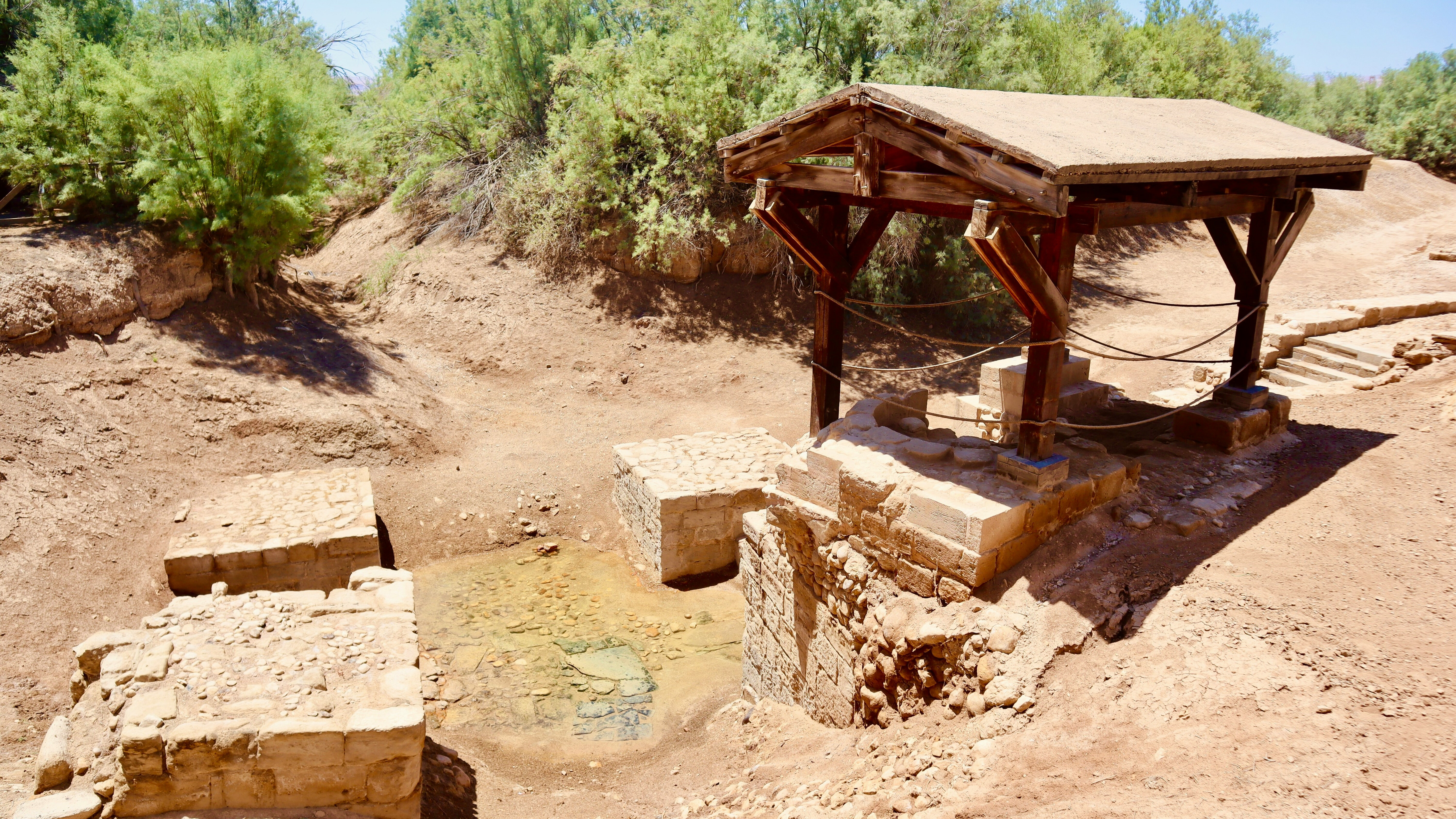
TLDR: Matthew 3:1-12 and Matthew 11:2-11 (Advent 2 and 3, respectively) give us a glimpse into the ministry of John the Baptist. Below you will find a bit more information about this fascinating character.
Matthew 3:1 begins, “In those days John the Baptist appeared in the wilderness of Judea, proclaiming, ‘Repent, for the kingdom of heaven has come near.’ Then it tells us that John fulfilled the prophet Isiah, that he symbolized the Jewish prophet, Elijah, in his manner of dress and his diet, and that he was an apocalyptic desert prophet who was quite popular and baptized thousands of people with a baptism of repentance for the forgiveness of sins.
Luke 1:5-24 adds additional information about John. He was the son of Zechariah, a priest of the day, whose turn it was to enter the holy of holies in the Temple for ritual cleaning. His wife was Elizabeth, a descendant of Aaron. The couple are described as “Blameless according to all commandments and regulations of the Lord.” An angel of the Lord announced to Zechariah that he was to have a child, even though he and his wife were past childbearing years:
“He will be great in the sight of the Lord. He must never drink wine or strong drink; even before his birth he will be filled with the Holy Spirit. He will turn many of the people of Israel to the Lord their God. With the spirit and power of Elijah he will go before him, to turn the hearts of parents to their children and the disobedient to the wisdom of the righteous, to make ready a people prepared for the Lord.”
There are great similarities between the John the Baptist narratives in the gospels and the stories of Old Testament characters. Like Abraham and Sarah, Zechariah and Elizabeth are elderly, barren, and childless. Like Samson (Judges 13-16), John is to be a modern-day Nazarite, who will abstain from alcohol and will dedicate himself to the service of the Lord. Like Elijah he will turn the hearts of parents to their children and vice versa. Other similarities between John and Elijah (1 Kings 17 through 2 Kings 2) are worth mentioning:
Similar preaching of repentance:
“Elijah went before the people and said, ‘How long will you waver between two opinions? If the Lord is God, follow him; but if Baal is God, follow him.’” (1 Kings 18:21)
“In those days John the Baptist came, preaching in the wilderness of Judea and saying, ‘Repent, for the kingdom of heaven has come near.’” (Mt 3:1-2)
Similar in appearance:
“The King asked them, ‘What kind of man was it who came to meet you and told you this?’ They replied, ‘He had a garment of hair and had a leather belt around his waist.’ The king said, ‘That was Elijah the Tishbite.’” (2 Kings 1:7-8)
“Now John himself was clothed in camel’s hair, with a leather belt around his waist’” (Mat 3:4)
Similar diet as desert prophets (God provided for them through whatever was found in their environment):
“Then the word of the Lord came to Elijah: ‘Leave here, turn eastward and hide in the Kerith Ravine, east of the Jordan. You will drink from the brook, and I have directed the ravens to supply you with food there.’” (1 Kings 17:2-3)
“And his food was locusts and wild honey.” (Matthew 3:4b)
Same message of judgement against the religious people of the day:
“He told the king, ‘This is what the Lord says: Is it because there is no God in Israel for you to consult that you have sent messengers to consult Baal-Zebub, the god of Ekron? Because you have done this, you will never leave the bed... You will certainly die!’” (2 Kings 1:16)
“But when he saw many of the Pharisees and Sadducees coming to his baptism, he said to them, ‘Brood of vipers! Who warned you to flee from the wrath to come?’” (Matthew 3:7)
Both stood in opposition to the kings of the day:
“I have not made trouble for Israel,” Elijah replied. “But you and your father’s family have. You have abandoned the Lord’s commands and have followed the Baals.” (1 Kings 18:18)
“Now Herod had arrested John and bound him and put him in prison because of Herodias, his brother Philip’s wife, for John had been saying to him: ‘It is not lawful for you to have her.’” (Matthew 14:3-4)
Both incurred the wrath of the queens of the day:
“So Jezebel sent a messenger to Elijah to say, ‘May the gods deal with me, be it ever so severely, if by this time tomorrow I do not make your life like that of one of them.’” (1 Kings 19:2)
“Prompted by her mother she said, ‘Give me here on a platter the head of John the Baptist…His head was brought in on a platter and given to the girl, who carried it to her mother.’” (Matthew 14:8, 11)
Both suffered depression and doubt:
“He came to a broom bush, sat down under it and prayed that he might die. ‘I have had enough, Lord,’ he said. ‘Take my life; I am no better than my ancestors.’” (1 Kings 19:4)
“When John, who was in prison heard about the deeds of the Messiah, he sent his disciples to ask him, ‘Are you the one who is to come, or should we expect someone else?’” (Matthew 11:2-3)
What Scripture adds about John’s role:
The greatest point of connection between Elijah and John is the prophecy of Malachi 4:5-6, “See, I will send you the prophet Elijah before the great and terrible day of the Lord comes. He will turn the hearts of parents to their children and the hearts of children to their parents, so that I will not come and strike the land with a curse.” When this prophecy was made, Elijah had been dead by hundreds of years, but the intent here is not re-incarnation. Rather, before Messiah arrives, one who embodies the type of the ancient desert prophet, Elijah, will arrive to fulfil the words of Isiah 3 (and others), “The voice of one crying out in the wilderness: ‘Prepare the way of the Lord, make his paths straight.’”
Jesus believes the prophesy of Malachi was fulfilled in his day through John, “A prophet? Yes, I say to you, and more than a prophet. For this is he of whom it is written: ‘Behold, I send My messenger before Your face, Who will prepare Your way before You.’ 'Assuredly, I say to you, among those born of women there has not risen one greater than John the Baptist.” (Matthew 11:7-11). Later, when asked, “How can you say you are the Messiah if Elijah has not come?” Jesus answered, “but I tell you that Elijah has already come, and they did not recognize him, but they did to him whatever they pleased. So also the Son of Man is about to suffer at their hands.” (Matthew 17:12).
The scriptures also tell us that the authorities of the day feared John and his disciples (Luke 20:1-8). In fact, even after his arrest and execution, John remained quite popular among many disciples in various parts of the known world of the day. He was a revolutionary preacher of righteousness and repentance, “For John came to you in the way of righteousness, and you did not believe him; but tax collectors and harlots believed him; and when you saw it, you did not afterward relent and believe him.” (Matthew 21:32, Mark 2:18.)
We know that John’s ministry was quite successful: A. Two of his disciples become Jesus Apostles (John 1:35-42). B. Apollos, an extremely important figure in the New Testament movement, had been an early disciple of John until he met Priscilla and Aquilla in 52 A.D. (Acts 18:25-26). C. Paul met 12 disciples of John in Ephesus and they seeded a congregation there (Acts 19:1-5). D. Jewish historian, Josephus, states that John’s movement was quite large and that Herod’s mistreatment of John was a cause for his military defeat. E. His movement had lasting impact beyond John’s life and strands of it have been found in various places even centuries after is death, “some scholars suggest a link to modern groups like the Mandaeans, who claim to continue the tradition of John.” (Zondervan Illustrated Bible).
As we approach the birth of Christ, let us take a moment to thank God for the ministry of John the Baptist. May his words and warnings help us to prepare the ground of our hearts for the coming of Messiah,
Blessings to all, Fr. Roman+